


The first exercises to preserve eyesight were created long before our era.Yogis, creating complexes for the whole body, did not forget about our eyes.They surely knew that for the best results you need not only training, but also proper rest.
The large amount of information that we "absorb" every day requires almost constant tension of our eyes.And, naturally, they get tired.Many vision problems are caused by overexertion.Even a person with a "one" needs a rest for the eyes.Otherwise, symptoms such as dry eyes, redness and blurred distance vision may appear after hard work.What can we say about those whose vision leaves much to be desired - in this case, rest for the eyes is simply necessary.It is not without reason that W. G. Bates and his student M. D. Corbet, when creating their system for improving vision, relied heavily on this fact.
The exercises and relaxation for the eyes that will be given below (this includes a complex of yoga and exercises according to W. G. Bates and M. D. Corbet) are quite simple and will not take much time.But... everything genius is simple and complex at the same time.Therefore, first try to carefully read the description of the exercise.If it is written that the movement should be smooth, that is important.If recommendations are given about how to breathe, pay attention to them.Do not forget about these "little things" and then exercise and rest will become the most effective.
First - rest.Palming
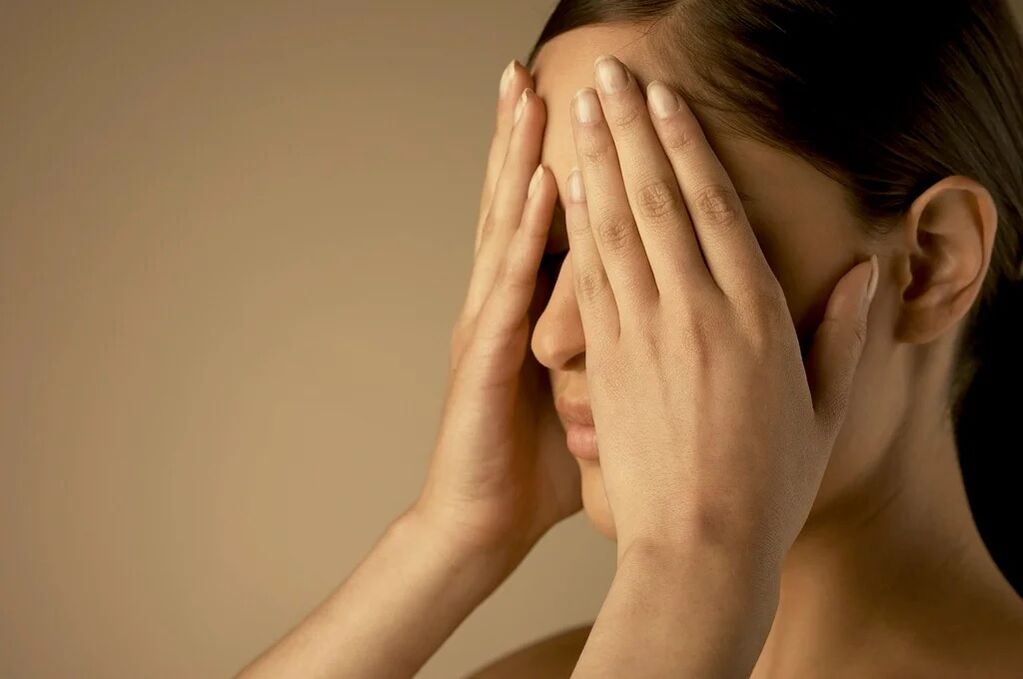
Sit up straight, relax.Cover your eyes like this: the middle of the palm of your right hand should be opposite your right eye, same with your left hand.The palms should lie softly, there is no need to press them hard on the face.The fingers can be crossed on the forehead, they can be next to each other - whatever is more convenient for you.The main thing is that there are no "slits" that let the light through.When you're sure of it, lower your shutters.The result is that your eyes are closed and, moreover, covered by your palms.
Now put your elbows on the table.The main thing is that the neck and spine are almost in one straight line.Make sure your body is not tense, and your arms, back and neck should be relaxed.Breathing should be calm.
Now try to remember something that makes you happy: how you were relaxing at the sea, how everyone congratulated you on your birthday, the starry sky... You can do this exercise with music.It is very difficult to consciously relax your eyes (remember you cannot control your heart either).Therefore, there is no need to try to control your condition - this will only harm the purpose of the lesson;instead, think of something pleasant.
You can also do the exercise at work, giving yourself short breaks.Even in 10-15 seconds your eyes will have time to rest a little.But, of course, it will be better if you take at least a few minutes to relax.
After you finish the exercise (especially if you have been doing it for a long time), gradually open your palms, let your closed eyes get used to the light a little, and only then open them.
"Writing with the nose"
This exercise aims to both relax your eye muscles and relax your neck.Tension in this area disturbs the proper nutrition of the eyes (in other words, the blood supply process slows down).
The exercise can be done lying down or standing up, but it is best to do it sitting down.Relax.Close your eyes.Imagine that the tip of your nose is a pencil with which you can write (or imagine that a long pencil continues the line of your nose - it all depends on what is more convenient for you, the main thing is that you and your eyes do not strain).Now write (or draw) in the air with your pencil.What exactly doesn't matter.Write different letters, names of cities and countries, a short letter to a loved one.Draw a house with smoke from the chimney (the same as you drew in childhood), only a circle or a square.
If you want to relax your eyes a little while sitting straight at your desk, you can imagine writing not with a pen, but with the tip of a needle on a needle head.Then your colleagues will not ask you what you are doing, because your head movements will be almost invisible from the outside.Employees will think you're just sitting with your eyes closed to get some rest.Which won't be far from the truth.In the same way, you can relax your eyes if you return from work by public transport.
"through my fingers"

Eye relaxation can be achieved by looking without concentrating on one thing.To relieve tension in the eyes, we suggest this exercise.It can be performed sitting, lying, standing.
Bend your elbows so that your palms are slightly below eye level.Open your fingers.Smoothly turn your head left and right, looking through your fingers into the distance, not at them.Let your gaze slide without dwelling on one thing.If you do everything right, your hands will "float" next to you: they should seem to move.
Do three turns alternately with your eyes open and three with your eyes closed (even closed eyes should not "hold" on anything. Do the exercise 20-30 times, breathing freely, without straining.
If you can't get the motion effect, try this.Extend your index finger.You should "look" up.And the nose should touch it.Close your eyes and turn your head left and right so that your nose touches your finger as it passes.Without stopping turning your head, open your eyes (just don't focus on the finger, look into the distance!).You will probably see the finger "move".
Morning complex
For those who find it difficult to open their eyes in the morning, this complex will be a real salvation.And if you can do your palms several times during the day (during the lunch break - longer, every 1-2 hours for at least 10-15 seconds) and "write" something with your nose (during the lunch break and on the way from work), you will feel that over time your eyes will not get tired as before.You can do some exercises at night.Especially if you watch TV, sit at the computer or read before going to bed.
So let's go back to the morning.
- Stretch well, roll several times from side to side.Do not hold your breath while doing this.On the contrary, breathe deeply and calmly.
- Open your eyes and mouth wide several times.
- Close your eyes tightly (6 times), make 12 light blinks.
- Do the "nose writing" exercise.
- Do the eyebrow exercise (see description below).
- Turn your fingers.
- Do the palms.
Palming should last about 5 minutes.The rest of the complex (6 previous exercises) should take the same amount of time.
Eyebrow exercise
In the morning, many of us want to say, like Gogol's Vi: "Lift my eyelids!"And over time they get harder and harder.Exercising your eyebrows will not only help your eyes release the pressure of this weight, but will also help you look younger.
Raise your eyebrows as high as possible, observing the sensation that appears at the top of your ears.Your task is to repeat this feeling over time without raising an eyebrow.Of course, not everyone can do this exercise right away.It is possible that when you lift your eyebrows for the first time, you will not notice any special sensations.Take your time, listen to yourself and you will succeed.
Basic yoga complex for the eyes
Yoga recommends this complex to maintain good vision.As the yogis themselves say, if you do this every morning and evening, starting from a young age, you can keep good eyesight until old age and not use glasses.
Before performing the complex, sit in a comfortable position (it is good if you can sit on your heels on the gymnastic mat, but you can also sit on a chair).Straighten your spine.Try to relax all muscles (including facial muscles) except those that support the sitting position of the body.Look straight ahead into the distance;if there is a window, look there;if not, look at the wall.Try to focus on the eyes, but without unnecessary tension.
Exercise no.1
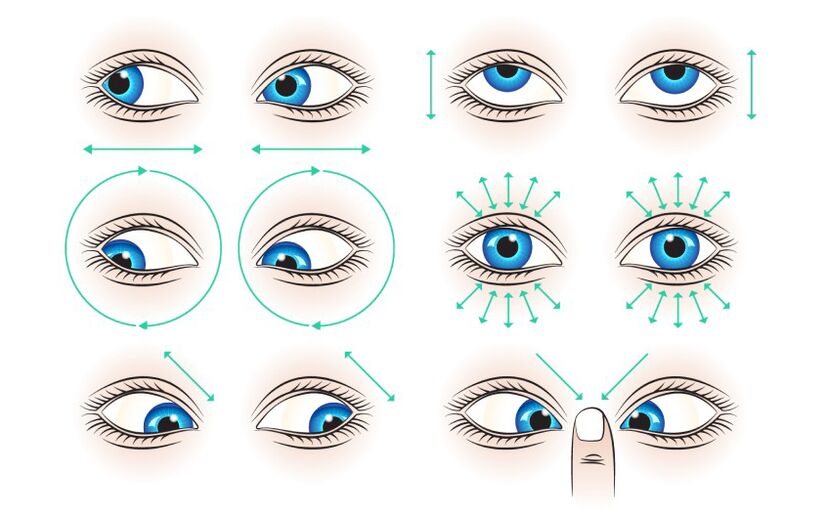
Breathing deeply and slowly (preferably from the stomach), look between the eyebrows and keep your eyes in that position for a few seconds.Exhaling slowly, return your eyes to their original position and close them for a few seconds.Over time, gradually (not earlier than after 2-3 weeks), the delay in the upper position can increase (after six months to a few minutes).Repeat the exercise 10 times.
Exercise no.2
Taking a deep breath, look at the tip of your nose.Hold for a few seconds and, exhaling, return your eyes to their original position.Close your eyes for a moment.Repeat the exercise 10 times.
Exercise no.3
While inhaling, slowly turn your eyes to the right ("all the way", but without much tension).Without pausing, while exhaling, return your eyes to their original position.In the same way, turn your eyes to the left.
Do one cycle to start, then two (after two to three weeks) and finally three cycles.After you finish the exercise, close your eyes for a few seconds.Repeat the exercise 10 times.
Exercise no.4
While inhaling, look to the upper right corner (approximately 45° from vertical) and, without pausing, return your eyes to their original position.On your next breath, look at the lower left corner and return your eyes to the starting position as you exhale.
Do one cycle to start, then two (after two to three weeks) and finally three cycles.After you finish the exercise, close your eyes for a few seconds.
Repeat the exercise 3 times.
Exercise no.5
Inhaling, lower your eyes down, then slowly turn them clockwise, stopping at the highest point (at 12 o'clock).Without pausing, begin exhaling and continue to roll your eyes clockwise downwards (up to 6 o'clock).To begin with, one round is enough, you can gradually increase their number to ten rounds (in two to three weeks).In this case, you must immediately start the second without delay after the first round.After you finish the exercise, close your eyes for a few seconds.Then do this exercise by turning your eyes counterclockwise.To complete the complex you need to do palming (3-5 minutes)
Concluding the section "Gymnastics for the eyes", we would like to note that in order to achieve the best results, you need to monitor your health in general.According to experts, good vision largely depends on proper nutrition, including the presence of sufficient vitamins.Remember that the healthiest food is natural (not artificial or canned) food, subject to minimal heat treatment.It is the one that retains the largest amount of useful substances.